Last class revision (5:12 PM)
- Latitude and longitude.
- Rotation and revolution.
Seasons (5:25 PM)
- Tabular presentation for various cases of earth's movement:
-
Conditions The angle of incidence(intensity). Length of the day Case 1:
No rotation.
No tilt.
No revolution.
90 degrees at the equator(higher intensity).
0 degrees at the poles(lower intensity).
24 hrs of day or night. Case 2:
Rotation is present.
No tilt.
No revolution.
90 degrees at the equator(higher intensity).
0 degrees at the poles(lower intensity).
12 hrs of the day and 12 hrs of the night across all the latitudes. Case 3:
Rotation is present.
Tilt(northern hemisphere towards the sun) is present.
No revolution.
90 degrees at 23.5 degrees north.
The intensity is higher in the northern hemisphere than in case 2.
In the southern hemisphere lower intensity than in case 2.
Equator- 12 hrs of day and night.
The length of the day increases toward the northern hemisphere and decreases toward the southern hemisphere.
Case 4:
Rotation, tilt, and revolution all are present.
90 Degrees at 23.5 degrees south.
The southern hemisphere has a higher intensity than case 2.
The northern hemisphere has a lower intensity than case 2.
Equator- 12 hrs of day and night.
length of the day increases in the southern hemisphere and decreases in the northern hemisphere.
- Seasons are periods of the year that are characterized by specific climatic conditions.
- There are 4 seasons- Summer, Autumn, Winter, and Spring.
- Seasons are observed on the earth because the earth revolves around the sun with a tilted axis of rotation whose angle of inclination is always constant.
- This causes variations in the intensity of sunlight and length of day throughout the year resulting in seasons
- The regions receiving higher intensity of sunlight for a longer duration experience higher temperatures resulting in summer.
- Those regions receiving lower intensity of sunlight for shorter duration experience winters.
- Diagramatic representation of earth and sun relation:
-
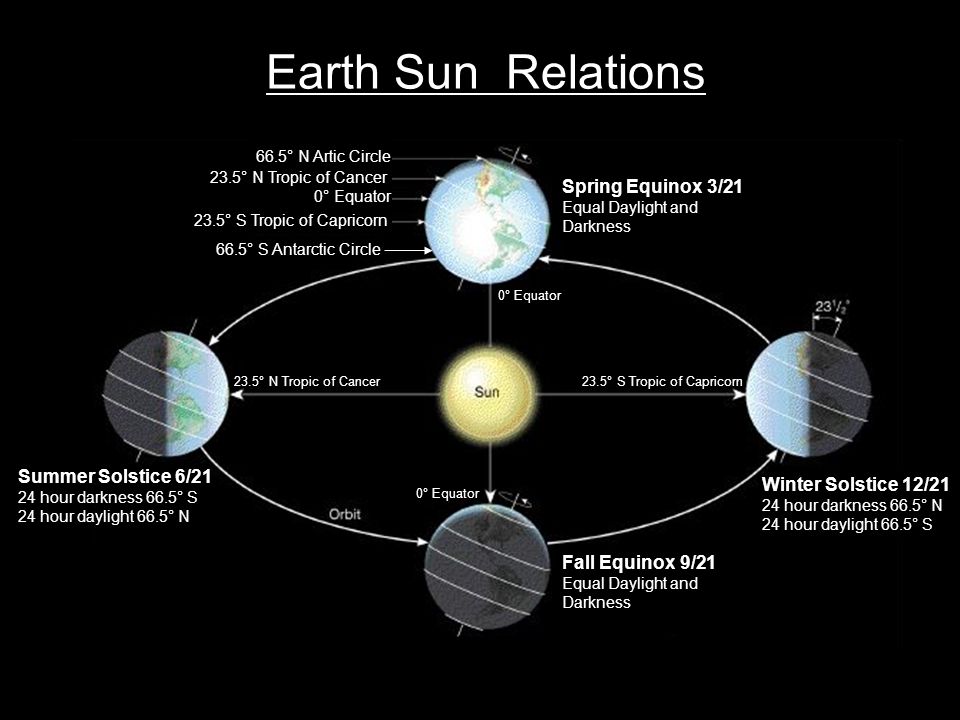
- Summer solstice:
- It occurs on 21st June.
- The sun's rays fall vertically at the tropics of cancer(23.5 degrees N).
- The intensity of sunlight has increased in the northern hemisphere.
- The length of the day increases from the equator to the north pole.
- Winter solstice:
- It occurs on 22 December.
- Sun rays fall vertically at the tropic of Capricorn(23.5 degrees S).
- The location of the southern hemisphere are receiving higher intensity of sunlight and those in the northern hemisphere lower intensity of sunlight.
- The length of the day decreases from the equator to the north pole.
- Equinox:
- It happens on the 21st of March(Spring Equinox) and the 23rd of September(Autumn Equinox).
- The sun's rays are falling vertically at the equator.
- The length of the day is 12 hrs along all the latitudes.
Video related to seasons (6:31 PM).
The extent of day and night (6:49 PM)
- Position of the overhead sun:
- It is a position where 90-degree sunlight falls.
- The position of the overhead sun is always between 23.5 Degrees N and 23.5 Degrees S.
- Every location between the Tropic of cancer and the Tropic of Capricorn will receive, at least 2 days of 90-degree sunlight and those which are located exactly in the tropics receive 90-degree sunlight only once.
- Polar day:
- It is experienced in regions with 24 hours of daylight.
- The maximum extent of a polar day is 66.5 degrees N and S.
- Polar night:
- It is when there are 24 hours of darkness.
Time Zones (7:20 PM)
- A time zone is a region of the globe that observes uniform standard time.
- The entire globe is divided into 24 time zones with the Greenwich meridian as a standard reference.
- The time along a particular longitude always remains the same.
- From the Greenwich meridian towards the east the time increases(EGA- east gain addition), and towards the west time decreases(WLS-west lose subtraction).
- With a change of every 15 degrees time changes by 60 mins, therefore with a change of every 1 degree, time changes by 4 mins.
- India follows 82.5 degrees east as Indian standard time.
- Multipule time zones:
- India followed 3 time zones based on Bombay, Calcutta, and Madras, along with local Chaibagan time in Assam.
- In 1906 India adopted 82.5 degrees east as Indian standard time(IST) and the local time zones of Bombay and Calcutta were continued till 1955.
- The longitudinal extent of nearly 30 degrees between East and West has resulted in a Mismatch of the Sun cycle and human activities.
- Issues in adopting multiple time zones in India:
- Economic integration- banking, stock exchange, etc.
- Administrative convince- offices, schools, etc.
- Issues in synchronization of transportation- Railways.
- Communication gap impacting security.
The topic of the next class: International Date Line and Origin of the Universe.